innovation talks
Collaboration on Green Research and Innovation
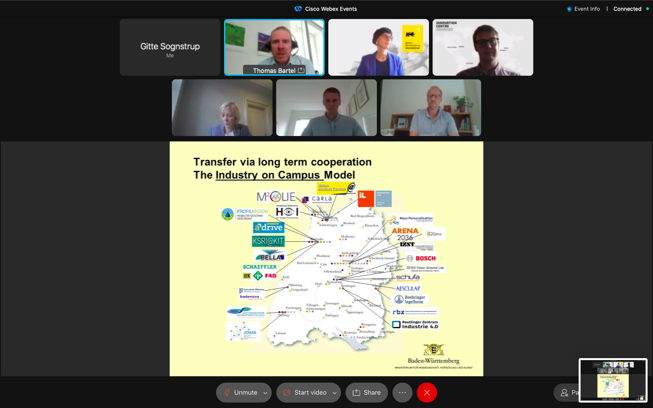
How can Industry-on-Campus deliver on the climate targets?
innovation talks
How can Industry-on-Campus deliver on the climate targets?
Read about Cyber Valley in the highlights from ICDK Munich’s Industry on Campus Camp in November 2020 [in Danish].
Learn more about Innovation Campus Mobility of the Future in our article here.
From a Danish perspective
Christian Bræin from the Danish Ministry of Higher Education and Science, presented the green research strategy of the Danish government: ‘Green solutions of the future - Strategy for investments in green research, technology, and innovation’.
In 2019, the Danish parliament adopted the Climate Act with a 70 percent climate reduction target by 2030 and climate neutrality in 2050. To reach these targets, the Danish government collaborates closely with industry - in 14 climate partnerships - which give recommendations sectors such as waste, energy, industry, agriculture, etc.
An important element in these climate efforts is R&I. Denmark has increased (public) investments in green R&I significantly - with more than one billion DKK since 2019.
“We need to develop existing technologies further and make them more cost-efficient. We also need to develop totally new solutions to be able to reach the targets,” Christian Bræin said.
The strategy has an international perspective. Through a call for “InnoMissions”, launched by Innovation Fond Denmark, Danish consortia are expected to connect with international partners and a strong research environment in other countries. Thus, there might also be a possibility for collaboration with partners in Baden-Württemberg, according to Christian Bræin.
Denmark: a pioneer in sustainable energy
The last speaker, Anne Marie Damgaard, from the Danish Center for Energy Storage (DaCES), emphasised that Denmark is a pioneer in sustainable energy, which is crucial for the green transition.
DaCES was launched in January this year with a two-year grant from the Danish Industry Foundation as a long-term green partnership between industry and academia.
There are great expectations to DaCES delivering a new adventure of export in collaboration with small and large companies, mobilising research and innovation in energy storage and conversion to develop a global position towards green transition and sustainability in 2030 and 2050.
“The aim is to create a place where corporates, SMEs and universities talk together, where we have a dialogue and transfer of the latest university knowledge. This, to make sure we accelerate the application of knowledge to companies,” Anne Marie Damgaard said.
“Research is needed - both on the short, medium and long term - to improve existing technologies, and to come up with radical new technologies.”
It therefore, DaCES aims for “systemic innovation and not point innovation”, according to Damgaard.
International partnerships
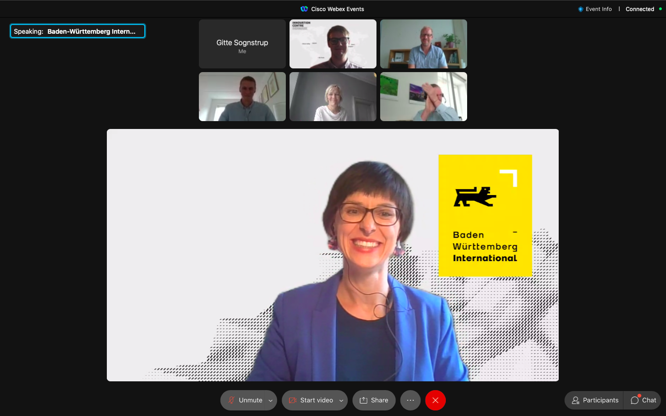
The Innovation Talk had a focus on regional partnerships, but all the speakers emphasized that international collaboration is crucial - also across the border.
“We need international cooperation to solve big questions. We cannot do it alone. We should address and encourage trans-border cooperation,” Thomas Bartel said.
“We are a regional university in Baden-Württemberg, but we are open-minded,” said Jens Pfafferott, who also invited the participants to visit the Institute of Energy System Technology in Offenburg.
According to Christian Bræin, all interested are welcome to contact the Innovation Fund Denmark, which can guide them to potential partners.
“And if you already have connections at Danish universities - reach out to them directly.”
This Industry on Campus Innovation Talk was the second out of two hosted by the Innovation Centre Denmark in Munich and Baden-Württemberg International. Read more about the events here.
Contact Research and Innovation Attaché, Ulrik Kjølsen Olsen:
+49 171 309 6314
ulkjol@um.dk